What Facility Managers Overlook in Commercial Disinfection
Disinfection failures rarely come from a bad contract. They usually come from small gaps in how work is planned, supervised, and documented on site, which show up quickly in health and safety or infection control reviews.
When flu and RSV start moving through buildings, those gaps become measurable business risk through absenteeism, lost billable hours, and disruption to core services. By that point budgets are already locked, so disinfection must sit in the risk register as a defined control, not as extra cleaning tacked onto a soft services schedule.
What Facility Managers Miss When Flu Season Hits
In many organisations, disinfection still gets treated as an extra spray or wipe inside a generic cleaning spec. It sits as a small clause instead of a separate control with its own task analyses, standard operating procedures (SOPs), and verification steps that can be produced in an audit.
Common gaps we see on commercial sites include:
- No clear trigger for escalating from routine cleaning to an outbreak or cluster response
- No documented communication path between cleaning, health and safety, and site or campus management
- No agreed evidence pack or format when executives, parents, or regulators ask what has been done
On paper, the contract often looks adequate. Execution is where the gaps appear, when health and safety, infection control, operations, and the commercial disinfection contractor are all working from different assumptions about scope and frequency.
Confusing Clean with Disinfected
A surface can pass a visual inspection and still carry enough viral load to drive transmission. Visible soil is only one risk indicator; health and safety and infection control teams need to see that disinfection products are approved for use in New Zealand and matched to the risk profile of the zone, whether that is a general office, classroom, or clinical area.
Typical failures we see during site walks and audits include:
- No validated dwell times, so products are wiped off before the contact time stated on the product label
- Incorrect dilution because staff guess instead of using measured dosing or a ready-to-use product
- No clear colour coding, so cloths and mops move between low- and high-risk zones
- No separation between routine cleaning methods and outbreak response methods documented in task analyses or SOPs
On well-managed commercial sites, a disinfection programme usually includes:
- Defined cleaning and disinfection frequencies by risk zone, linked to the risk register
- Detailed touch-point lists for each area type that supervisors can sign off against
- Colour-coded tools and equipment consistent with health and safety and infection control protocols
- ATP or microbial validation where required by internal standards or external audits
That structure allows facility managers to show traceable controls during incident reviews, insurance questions, or regulator queries.
Overlooking Touch Points That Actually Drive Transmission
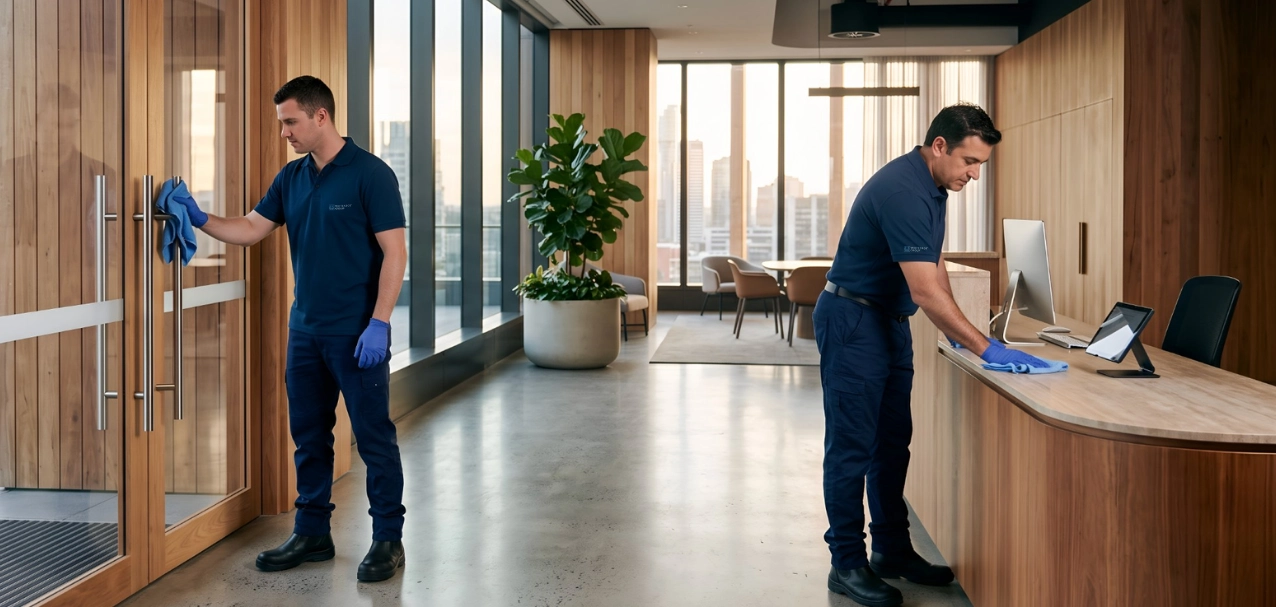
High-risk touch points are often small, easily missed, and used by hundreds of hands in a shift. During site inspections, we frequently find gaps around:
- Lift buttons and card readers
- Tap handles, railings, and chair backs in shared spaces
- Shared radios, tablets, scanners, and phone handsets
- Locker doors, forklift controls, and kitchenette appliances
Asset registers and cleaning schedules typically list spaces such as amenities, workstations, and breakout areas. That language does not specify ownership for the microwave handle, shared RF scanner, or radio on a loading dock, so contractors and in-house teams can each assume the other has it covered.
A practical risk assessment with your contractor should:
- Map people-flow through the site by time of day and shift pattern
- Identify high-load areas such as entry points, change rooms, and break or meal areas
- Check access limits, security zones, and production schedules so work can be sequenced safely
- Turn that information into a touch-point disinfection plan that is realistic against labour hours
Without that mapping, disinfection effort often lands where it is convenient, rather than where it reduces transmission and supports health and safety objectives.
Ignoring Regulatory Triggers in Schools and Care Settings
Schools and early learning services that operate under the Education (Early Childhood Services) Regulations 2008 and the ECE licensing criteria carry additional documentation duties. During illness outbreaks, public health services and regulators can ask to see:
- Documented infection control procedures that align with current health guidance
- Copies of parent communications and notices about outbreaks
- Outbreak response logs that show what was cleaned or disinfected, when, and by whom
Many facility managers rely on generic 'clean daily' clauses in the cleaning contract and assume that is sufficient. In practice, regulators usually expect specific disinfection rounds that align with the service's health policies and local public health service directions, and they expect to see those rounds documented.
A capable commercial disinfection contractor can support this by supplying:
- Up-to-date chemical registers and Safety Data Sheets (SDS) for all disinfectants in use
- Training records that show cleaners have been instructed in infection control tasks and PPE
- Task analyses and SOPs that align with the service's health policies and outbreak plans
- Incident and exception reports that can be provided during a compliance visit, licensing check or ERO review
This level of documentation reduces pressure on teaching and care staff, who should not be left to reconstruct cleaning methods for regulators from memory.
Underestimating Validation, Reporting and ISO Alignment
A cleaning specification describes tasks. An ISO-aligned integrated management system links those tasks to risk registers, task analyses, environmental objectives, and incident management, which is what auditors look for when they test the effectiveness of controls.
Practical validation methods on commercial sites can include:
- ATP testing on selected high-risk surfaces, with defined pass-or-fail thresholds
- Photographic evidence of completed work for outbreak zones, tied to job numbers
- Site-specific digital checklists linked to QR codes in each area, with time and user stamps
- Exception reports when rooms are locked, access is denied, or work is deferred for safety reasons
Selecting a commercial disinfection contractor that works to ISO 9001, ISO 14001 and ISO 45001 systems means that evidence is structured and traceable. That makes it easier to track non-conformances, corrective actions, and environmental impacts, such as chemical selection and waste handling.
Relying on Untrained Labour During Outbreaks
When flu or gastro hits, many sites default to improvised responses. Casual staff, security, or admin teams are given a spray bottle and cloth and asked to wipe everything down, which is understandable operationally but rarely acceptable under health and safety or infection control standards.
Common problems we see during these ad hoc responses include:
- Incorrect or no PPE, exposing staff to avoidable biological risk
- Cross-contamination as the same cloth or mop moves between toilets and food or break areas
- Chemicals being mixed in buckets or spray bottles without reference to SDS or labels
- Incompatible disinfectants being used on sensitive surfaces or clinical equipment, causing damage or residue issues
Facility managers should expect their commercial disinfection contractor to provide a structured surge response that has been tested. That usually includes:
- Trained outbreak teams who are familiar with the site layout and access requirements
- Job-hazard analyses and task analyses that are specific to the outbreak scenario and pathogen type
- Toolbox talks or pre-start briefings so everyone understands zones, methods, and PPE
- Clear segregation of equipment and waste handling for contaminated areas, in line with site waste procedures
This approach protects people and plant, and it leaves a clear evidence trail for any post-incident review, insurance discussion, or regulator enquiry.
Turning Disinfection Gaps Into a Site Strength
Disinfection should sit in the same risk conversation as fire, electrical safety, and contractor management. It should not be treated as a soft service that is reduced whenever budgets tighten, because outbreaks quickly turn into productivity and compliance issues.
A practical way forward is to run a structured review with your current or prospective commercial disinfection contractor before peak illness season. Walk the site together, map people-flow, review existing documentation, and test the current scope against health and safety obligations, sector-specific requirements, and the organisation's risk appetite so that gaps can be converted into clear actions with owners and timelines.
Get Started With Your Project Today
If you are looking for a reliable commercial disinfection contractor, we can tailor a solution to suit your workplace, schedule and compliance needs. Our team at White Spot Group focuses on thorough, consistent results that help safeguard staff, clients and visitors. To discuss scope, timing and a clear quote, simply contact us and we will walk you through the next steps.