Questioning Hospital Grade Cleaning Services Beyond the Label
Hospital-grade cleaning services should not be a logo on a brochure or a throwaway line in a tender. For hospitals, day surgeries, and other clinical facilities, cleaning performance is tied directly to infection risk, regulator attention, and board-level questions when something goes wrong. Every autumn, as flu, RSV, and other respiratory infections start to pick up, facility and asset managers feel that pressure.
Experienced facility teams have sat on the other side of the table, explaining cleaning data to clinical governance, health and safety committees, and auditors. When those groups start asking about standards, product approvals, and measured outcomes, marketing phrases disappear very quickly. This article steps through how to interrogate hospital-grade claims, what good practice looks like on site, and how to make sure your contracts and SLAs line up with the actual infection risks in your buildings.
What Hospital Grade Should Really Mean on Your Site
Hospital-grade cleaning services should start with standards, not slogans. On any clinical or acute site, that means clear alignment with documented disinfectant efficacy evidence and Medsafe requirements, and with the relevant AS/NZS standards where reprocessing or sterile services are in scope, such as AS/NZS 4187 for reprocessing of reusable medical devices. It also means working against recognised national infection prevention guidance, such as Te Whatu Ora — Health New Zealand infection prevention and control guidance and the Ngā Paerewa Health and Disability Services Standard, not whatever the closest wholesaler has in stock this month.
The label on a bottle is only one small part of the story. Product choice needs to sit inside an end-to-end system that covers:
• Colour coding for wipes, mops and cloths so cross-contamination is controlled
• Clear rules on where single-use wipes are mandatory and where reusable microfibre is acceptable
• Dwell times written into cleaning procedures, not left to guesswork
• Documented cleaning paths that reduce backtracking and re-contamination
On a true hospital-grade site, cleaning does not sit off to the side from health and safety or clinical risk. It plugs straight into your existing systems. That means:
• Risk registers that identify specific areas like theatres, procedure rooms, isolation rooms and public zones
• Health and safety hazard reports that trigger changes to tasks, products or PPE, not just a file note
• Links to infection surveillance data, so a spike in a unit leads to a review of frequencies and methods
If a provider cannot explain how their cleaning system fits into your broader risk and governance structures, you are not talking about hospital grade, you are talking about general contract cleaning.
The Red Flags Hidden in Hospital Grade Contracts
When cleaning contracts that claim to be hospital grade are reviewed, the first warning signs are often in the scope wording. Broad phrases look neat on paper but fall apart under audit. Watch for terms like:
• "All high-touch areas" with no actual list by room or asset type
• "Cleaned as required" for clinical or waiting areas without any trigger criteria
• "Terminal clean as per facility policy" with no reference to a written SOP or checklist
If the language is vague, the delivery will be inconsistent. The same applies to task analyses and inductions. A provider that talks about hospital-grade cleaning services but cannot produce task-specific task analyses for:
• Isolation rooms
• Operating theatres or procedure rooms
• Negative pressure rooms or pandemic zones
is putting your organisation at risk. Generic task analyses copied across from an office portfolio are not acceptable in a clinical environment.
Contract structure is another weak point. Time-and-materials arrangements without a documented QA programme tend to fail when surveyors or regulators visit. Red flags include:
• No ATP or fluorescent marker audits written into the schedule
• No agreed non-conformance process, with timeframes and escalation points
• QA that is based only on visual inspections, with no data trail or evidence
If you would feel uncomfortable showing the contract to an external auditor, you already know it is not supporting the level of claim being made.
Turning Compliance Talk Into Auditable Evidence
When someone claims to provide hospital-grade cleaning services, you should be able to ask for proof and receive it quickly. At a minimum, a serious provider should be able to show:
• ISO 9001, 14001 and 45001 certifications, current and independently audited
• Site-specific SOPs that match your layout, risk zoning and specialty areas
• A list of disinfectant products with documented efficacy evidence, mapped against risk zones and cleaning tasks
On top of that, you should see a clear QA framework. In practice, that often includes:
• ATP swabbing in defined locations and frequencies, with agreed pass/fail thresholds
• Fluorescent gel or powder checks to verify that cleaners are following paths and touchpoint lists
• Regular observational audits with photo evidence, not just tick-box forms
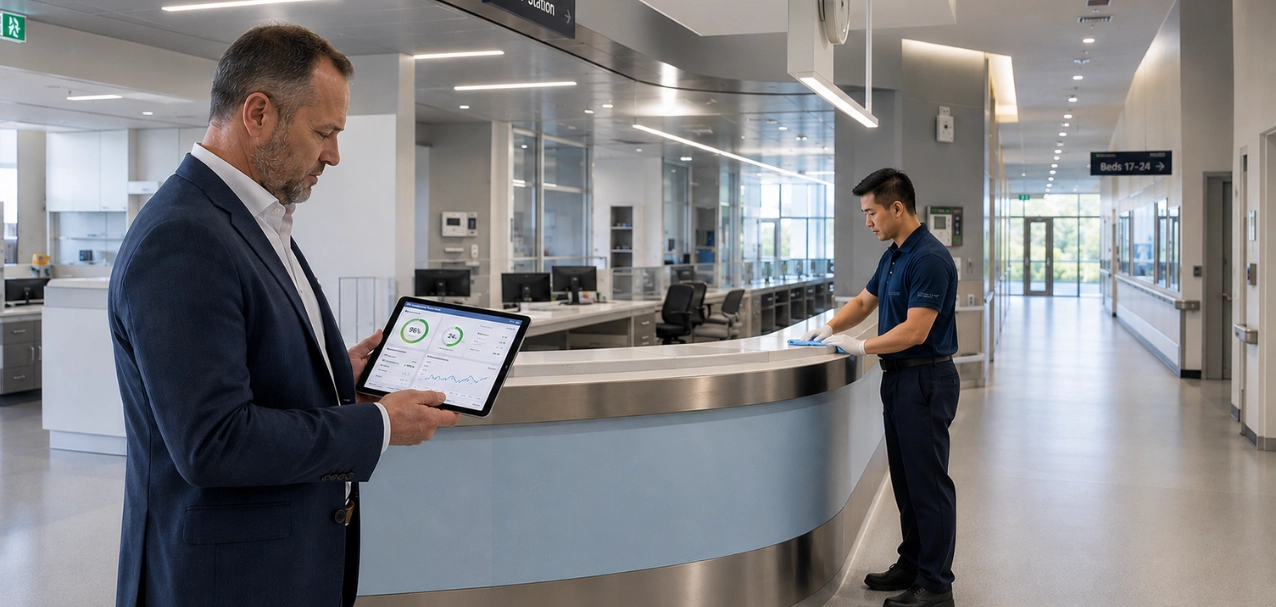
All of this should be captured in a digital reporting system, not in a folder on a trolley. The platform should give your facility team:
• Visibility of non-conformances and the time taken to close them out
• Staff competency and training records that link to the Ngā Paerewa Health and Disability Services Standard or local clinical policies where applicable
• Traceable evidence of refresher training after incidents, complaints or audit findings
If a provider talks a lot about compliance but struggles to show this kind of evidence on short notice, that gap should be treated as a risk.
Preparing for Winter Surges and Outbreak Scenarios
April is the point where many facilities start to feel the lift in respiratory cases. Occupancy tightens, visitor volumes change and every cough in a waiting room feels like a potential cluster. This is where the difference between a marketing phrase and a real hospital-grade system becomes obvious.
A genuine hospital-grade cleaning service will be able to walk you through how they support your outbreak management plan. That should include:
• Surge staffing models for cleaning teams when admissions or case numbers jump
• Pre-defined intensified touchpoint schedules for lifts, handrails, reception areas and staff stations
• Clear zoning and segregation plans for suspected or confirmed outbreak areas
Task analyses and method statements should not be static. When your facility moves into an outbreak posture, your provider should rapidly update:
• Task analyses to reflect new PPE requirements or room entry controls
• Task lists to include extra cleans between patient transfers or procedure lists
• QA frequencies to give you more data and assurance in higher risk periods
Supply chain resilience is another real-world test. Facility managers need confidence that critical disinfectants, PPE and single-use consumables will be available when the wider market tightens. Asking for evidence of contingency planning, secondary suppliers and minimum stock holdings is part of that responsibility.
Questions to Ask Before You Renew Another Contract
Before you sign off on another year of "hospital-grade cleaning services", it is worth slowing down and asking some pointed questions. For example:
• What efficacy evidence and regulatory approvals sit behind your disinfectants, and how are they matched to risk zones on our site?
• Can you show us your site-specific SOPs, task analyses and QA schedule for our highest risk areas?
• How do you use ATP, fluorescent checks or other methods to verify cleaning outcomes, not just effort?
• How does our infection data or incident reporting change your cleaning frequencies or methods?
• What did you change during the last flu or gastro surge and how quickly did you implement those changes?
Joint site walks that bring together infection control, health and safety representatives and cleaning supervisors are often more valuable than another capability statement. Spend time on actual workflows, like how a cleaner moves through a ward, handles equipment, changes PPE and records completion. Capability statements and glossy documents are easy to produce. Safe, compliant and data-backed cleaning on a live site is harder.
Facility managers across hospitals, day surgeries and other regulated clinical environments are under pressure to justify every line on a risk register. The more your cleaning contracts and SLAs are aligned with real infection risks and audit obligations, the easier those conversations become at the executive and board level. If the words "hospital grade" appear in your documents today, it is worth checking that the evidence, systems and people behind them can stand up to the next seasonal surge and the next external audit.
Get Started With Your Project Today
If you need meticulous, reliable results for a sensitive or high-risk environment, our team at White Spot Group is ready to help. Explore our specialised hospital-grade cleaning services to safeguard your staff, patients and visitors with a cleaner, healthier space. To discuss your specific requirements or request a tailored quote, simply contact us and we will respond promptly.