Inside ECE Licensing Cleaning Compliance for Early Learning Centres
Cleaning compliance is not about looking tidy for parents. It sits at the centre of whether a service is assessed as safe, hygienic and fit for purpose under the ECE licensing criteria and the Education (Early Childhood Services) Regulations 2008.
Ministry of Education licensing staff and ERO reviewers use those criteria as the standard, not as background reading. Cleaning practice shows up quickly against the health and safety practices criteria and the premises and facilities criteria. When cleaning systems fail, the risk lands on the licensee and the person responsible, and that shows in review outcomes.
What Reviewers Actually Look For Around Cleaning
There is no ready-made national cleaning checklist for education and care services or OSCAR programmes. Instead, reviewers test practice and records against the Education and Training Act 2020, the Education (Early Childhood Services) Regulations 2008, and the licensing criteria. In particular, they commonly focus on:
- The criteria covering health, hygiene and the management of infectious disease
- The criteria covering premises, sleep spaces, nappy change areas and nappy change facilities
- The criteria covering the design, layout and maintenance of the premises
On-site, reviewers typically look for practical evidence that cleaning is planned, performed, and recorded. This often includes cleaning schedules signed per shift or session and matched to each room, product registers and Safety Data Sheets (SDS) for all chemicals used, infection control procedures that align with the service’s own policies, and incident and illness reports that link back to specific cleaning actions.
Common non-compliances are consistent across services. Facility teams frequently see inconsistent bathroom sanitising (especially late in the day), weak nappy change hygiene with poor cleaning of mats and change tables, cross-contamination from shared cloths and buckets across areas, and poorly documented responses to gastro, RSV or influenza outbreaks.
From a facility perspective, the principle is straightforward: if a process is not documented, trained, followed and signed, a reviewer will assume it does not exist.
Building A Cleaning Regime That Survives Review
Generic AM/PM office schedules rarely work in early learning environments. Cleaning must be built around how each room operates over the day, and mapped to:
- Room type (infants, toddlers, over-twos, OSCAR)
- Sleep periods and rest times
- Mealtimes and food preparation
- Indoor and outdoor transitions and sandpit use
Tasks should then be grouped by frequency and risk level so educators and cleaners understand what matters most and when it needs to happen. Typical groupings include:
- Touchpoints: door handles, cot rails, light switches, nappy change surfaces
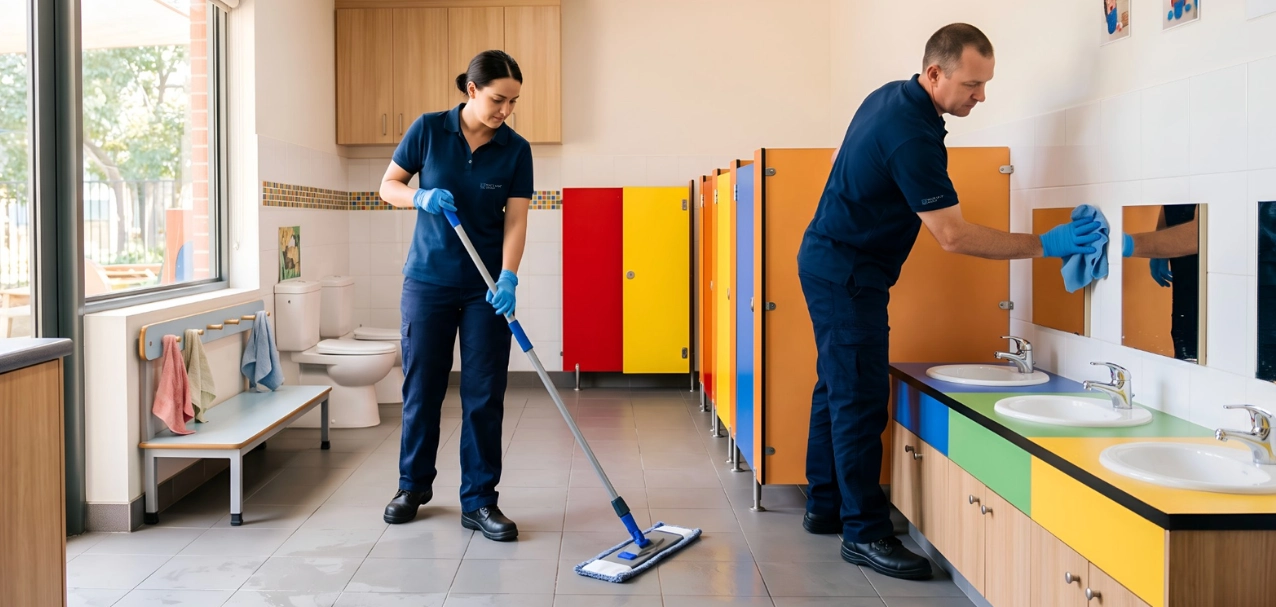
- Nappy change and bathrooms: change mats, toilets, potties, hand basins, floors
- Sleep equipment: cots, sleep mats, bedding storage areas
- Outdoor areas: sandpits, fixed play equipment, outdoor tables
- Food service: kitchen, bottle prep, trolley handles, highchairs
However, grouping tasks is only part of what reviewers are looking for. Each task needs a clear method, not just a dot point on a checklist. This is where task analyses and method statements become critical. They should explain correct chemical selection, dilution and contact times based on manufacturer Safety Data Sheets; how colour-coded cloths and mops are used for defined zones to prevent cross-contamination; PPE expectations for cleaners and escalation points for educators; and storage and isolation of chemicals away from children and food preparation areas.
When a reviewer asks how a surface is disinfected, the team should be able to point to the schedule, the task analysis, the product label and the practice observed on the floor. Inconsistent answers across shifts are a common red flag.
Infection Control, Winter Illness And Outbreak Protocols
From autumn into winter, most services experience increased RSV, influenza and gastro. This is usually when it becomes clear whether cleaning exists only on paper or operates as a functioning infection control system.
An effective plan builds outbreak response into day-to-day routines. Facility managers often establish escalation levels, for example:
- Level 1: Routine daily cleaning and disinfection
- Level 2: Increased touchpoint disinfection when illness numbers rise
- Level 3: Targeted zone isolation and deep cleaning during an active outbreak
For each level, services should spell out exactly what changes. That includes which rooms or zones to prioritise, extra disinfection rounds for bathrooms, nappy change and sleep areas, and how to respond to public health advice and internal illness policies.
Practical controls are where many services fall short. At a minimum, a compliant system will have:
- Disinfectants with appropriate virucidal claims and contact times suitable for early learning settings
- Written vomit and faecal clean-up procedures, with defined PPE and product steps
- Bin management standards, including liners, lids, and removal frequency
- Hand hygiene support for children and staff, linked to cleaning of basins and dispensers
- Cleaning logs that correlate with illness records, showing what changed and when
When a reviewer looks at an outbreak, they want a clear link from illness trends to cleaning responses, backed by records rather than staff recollection. Gaps between logs and illness data will invite further scrutiny.
Integrating Cleaning Into Internal Evaluation, Health and Safety And ISO Systems
Cleaning should sit within your internal evaluation and improvement planning, not in a separate operational silo. Every near miss or non-conformance can drive a specific action, for example:
- Slip incident near a bathroom: review and adjust floor cleaning timing and products
- Repeated nappy change concerns: retrain against the task analysis and adjust frequencies
- Parent complaint about odour: investigate waste routines, ventilation and cleaning scope
Where services use contracted cleaners, an ISO-aligned provider should operate through documented procedures, internal audits and KPIs. In practice, this usually means standardised cleaning procedures across all rooms and services, environmental controls on water, chemical use and waste handling, and regular auditing against agreed checklists and regulatory expectations.
Health and safety requirements under the Health and Safety at Work Act 2015 must overlay all cleaning activity. Before any cleaning task, there should be:
- Risk assessments for chemical exposure and manual handling
- Contractor inductions that explain site-specific risks and child-safe practices
- Safe access procedures for out-of-hours work, including alarms and keys
- Clear rules so educators are not asked to complete high-risk cleaning tasks without training or PPE
When internal evaluation, health and safety and contractor systems align, it becomes much easier to demonstrate cleaning compliance at any point in the licensing and review cycle. It also reduces unplanned downtime from incidents and near misses linked to cleaning.
Selecting And Managing A Contractor Who Understands ECE
Not every commercial cleaner understands education and care services, OSCAR programmes or the licensing criteria. When selecting a contractor, facility managers should look beyond price and ask about:
- Direct experience in early learning and education environments
- Understanding of the ECE licensing criteria and the Education (Early Childhood Services) Regulations 2008
- Ability to provide task analyses, NZ Police vetting and safety checks under the Children's Act 2014
- Evidence of any immunisation requirements set by the service or health guidance
A detailed contract and scope of works is essential for accountability. Strong scopes typically include:
- Room-by-room task lists, with clear frequencies and measurable outcomes
- Service levels for increased disinfection during illness spikes
- Product standards that align with health, safety and environmental policies
- Response expectations for incidents like bodily fluid spills
- Audit and reporting cadence that lines up with internal evaluation and board reporting
Centre managers and facility managers remain responsible for supervising performance. Practical tools include:
- Joint site walks with educators and the contractor supervisor
- Sign-off of cleaning logs by both parties
- Photo evidence for corrective actions and periodic deep cleans
- Annual reviews linked to your licensing and ERO review cycles
Turning Compliance Into A Stable, Defensible Routine
Cleaning in early learning affects pedagogy, family confidence, health and safety and regulatory risk every day. When systems are documented, trained and audited, the person responsible carries less personal risk and licensees can demonstrate compliance on demand.
A practical way forward is to run a structured gap review before the next respiratory peak. Put current cleaning schedules, task analyses, infection control plans and logs on the table, and compare them directly against the licensing criteria and what actually occurs on the floor. Involving both educators and the cleaning contractor makes the final system realistic and defensible in a review or incident investigation.
Protect Your Service With Proven Compliance Support
Staying on top of ECE cleaning compliance can be complex, but we make it straightforward and practical for your centre. At White Spot Group, we work with you to align cleaning routines, documentation and reporting with current regulatory requirements. If you are ready to review or upgrade your cleaning standards, reach out to our team via contact us so we can tailor a solution that fits your service.