Getting Compliant Cleaning Off the Paper and Into Practice
A compliant cleaning schedule looks straightforward in a policy folder until the service opens. Ratios are tight, nappies need changing, arrivals and departures stack up, and that laminated checklist on the wall fades into the background. When a licensing assessment or ERO review starts, reviewers expect to see that those documents drive what happens on the floor, not just sit in a file.
In education and care services and OSCAR programmes, the issue is usually systems, not intent. Leaders care about children’s health, but cleaning is often left to whoever has a spare minute instead of a structured programme linked to the ECE licensing criteria and your health and safety obligations. That gap shows up in infection patterns, inconsistent records and findings at review.
From a facilities and operations point of view, compliant early learning cleaning is a documented, risk-based method. It must align with the licensing criteria covering children’s health and safety and those covering the physical environment, and it has to be woven into room routines instead of bolted on. The examples below reflect how that looks in actual rooms with real staffing, not in a theoretical checklist.
What Compliant Early Learning Cleaning Really Requires
The licensing framework requires clear connections between the regulations, service policies and daily practice. For cleaning and hygiene, the key drivers are the licensing criteria made under the Education (Early Childhood Services) Regulations 2008 that cover:
• Health, hygiene and safe food practices in every room and food area
• Documented policies on infection control and the management of illness
• Managing infectious disease, including exclusion of unwell children and staff
Licensing staff and ERO reviewers test alignment in several ways. They review written cleaning schedules, talk with educators and leaders, and cross-check incident records such as gastro outbreaks. If the schedule specifies hourly bathroom checks but illness records and staff feedback do not support that, the inconsistency is noted.
Risk assessments and task analyses are where cleaning frequencies and methods should be locked in. High-risk zones such as bathrooms, nappy change areas, food preparation spaces and sleep rooms need higher touchpoint frequencies than general playrooms. Health and safety risk ratings should flow directly into:
• Documented touchpoint lists by area
• Task frequencies by room and by time of day
• Specified chemicals, cloth colours and tools
It is important to separate presentation cleaning from infection control cleaning in the documentation. Presentation cleaning keeps spaces visually acceptable, dealing with visible spills, fingerprints on glass and sand on floors. Infection control cleaning targets microbial load on high-touch surfaces and responds to bodily fluid incidents under the service’s infection control procedure.
For example, detergent-only cleaning is usually sufficient for visible dirt on tables before craft, in line with public health guidance. A disinfectant with proven efficacy and a documented dwell time is required for nappy change mats, toilet flush buttons and vomit or blood clean-up, following manufacturer instructions and service procedures. These distinctions should be captured in job cards and site manuals so room staff and contract cleaners apply the same method every time.
Building a Daily Cleaning Rhythm That Educators Can Sustain
A workable daily cleaning programme has to reflect how the service actually runs. Generic morning, afternoon and night charts rarely match ratios, sleep routines and transition pressures. Mapping cleaning to session changes, meal times and sleep blocks allows tasks to be completed without undermining supervision requirements under the licensing criteria and the Health and Safety at Work Act 2015.
A practical room-level plan could include:
• Short touchpoint wipes of door handles and benches at each major transition
• Toy and table cleaning linked to pack-up before outdoor play or meal service
• Bathroom spot checks aligned to established nappy change blocks
Responsibilities need to be unambiguous. Labels like "staff" or "educators" on a chart do not create ownership or accountability. A basic responsibility matrix is more effective, with roles such as:
• Room leaders: oversee daytime toy and surface cleaning, and initiate incident cleaning under the infection control policy
• Educators: complete programmed wipes and spill responses within their room routine
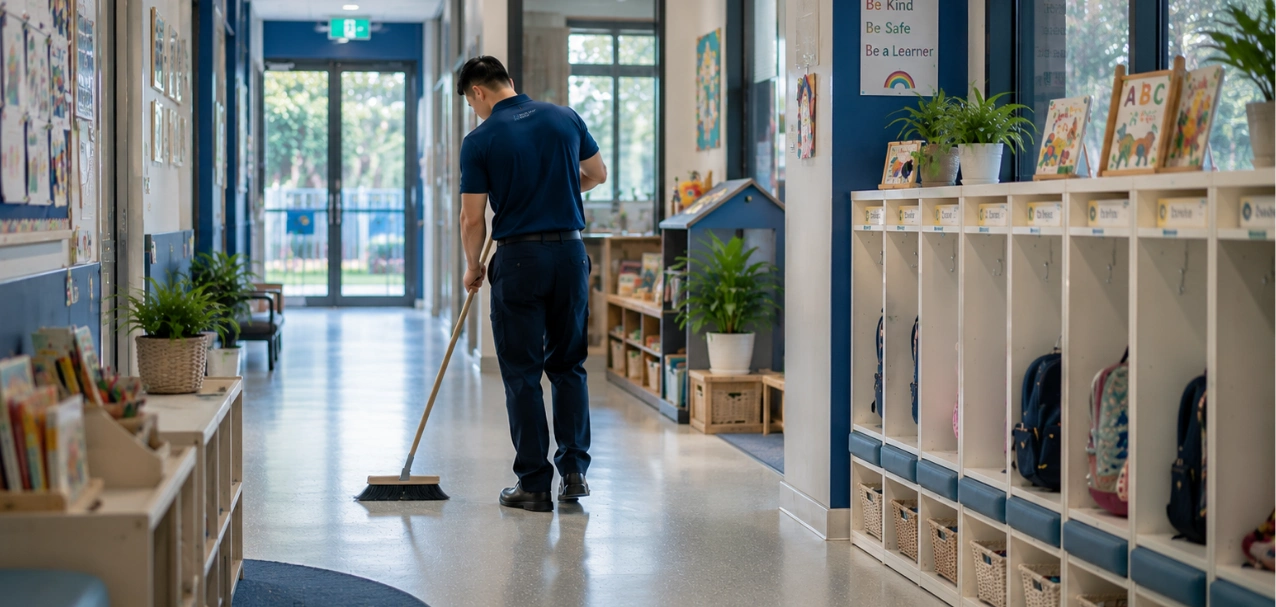
• Contract cleaners: perform end-of-day bathroom sanitising, machine scrubbing of floors, and full kitchen cleaning in line with the scope of works
Documentation must integrate with daily routines to be sustainable. In practice, this can include wall charts in each room listing daily and sessional tasks in plain, operational language. Many services now use QR-coded checklists on phones or tablets with time-stamped sign-off, tied to room or area.
Linking cleaning documentation to incident records strengthens evidence at review. For example, a vomit incident in a sleep room should automatically generate an enhanced clean entry under the infection control procedure. This approach keeps your evidence auditable and transparent, rather than relying on informal statements about cleaning being done "when needed".
Weekly and Monthly Deep Cleans That Stand up to Scrutiny
Daily tasks manage visible risk, but weekly and monthly work demonstrates planned, preventative control. Weekly work programmes in early learning facilities commonly include full cot, mattress and bed frame cleaning, and cleaning of vents, high ledges and fans. Toy rotation and disinfection cycles by room, along with deep cleaning of food service areas and appliances, should be scheduled and recorded.
These tasks are best tied to the service calendar rather than left to informal decisions. Examples include setting a fixed day per room cluster or a routine Friday afternoon block for specific deep clean items, subject to enrolment and staffing patterns. If these tasks depend on spare capacity, they are often the first to be dropped during staff shortages or high-demand periods such as school holidays.
Monthly or term-based programmes generally cover heavier assets and building elements. Common examples are machine scrubbing of hard floors in bathrooms, kitchens and high-traffic corridors, and carpet extraction in sleep rooms, infant rooms and soft play zones. Descaling of taps, toilets and change area fixtures, along with water blasting of external play paths and entries, should also sit in this cycle.
These planned works should appear consistently in both maintenance and cleaning logs, including digital job reports and photo evidence where available. That record set allows a reviewer to confirm that the service is not waiting for mould, odour or complaints before acting, and it gives facilities teams data points for budgeting and lifecycle planning.
A contractor running quality, environmental and safety management systems built to ISO 9001, ISO 14001 and ISO 45001, with a planned maintenance programme, a validated chemical range and suitable equipment, can support this approach. From a facilities management perspective, a single, integrated record set from the contractor simplifies internal auditing and reporting for licensing and corporate governance.
Infection Control, Flu Season and Outbreak-Ready Schedules
Early learning services see predictable seasonal pressure from respiratory and gastrointestinal illness, particularly in cooler months. A compliant cleaning schedule should include explicit triggers for an escalated cleaning response. Triggers can be based on local public health alerts, internal illness records reaching a defined threshold, or guidance from public health authorities.
An escalated cleaning mode typically includes increased disinfection frequency for door handles, cot rails, tablets and sign-in kiosks. It can also involve more frequent cleaning and disinfection of sleep rooms and soft furnishings, and additional attention to bathroom floors, partition edges and toilet flush buttons. Documented use of disinfectants with verified efficacy against enveloped viruses, with required dwell times stated on job cards, is essential.
Linking infection control cleaning changes to worker engagement processes helps maintain buy-in and safety. Toolbox talks and safety briefings should cover correct PPE selection and disposal, colour-coded cloths and mops to prevent cross-contamination, and the right dilution, contact time and rinsing for each chemical as per the Safety Data Sheet. Waste handling and bin management during outbreaks should also be included, with reference to local council waste requirements and the service’s infection control policy.
Contractors engaged for outbreak response should be able to provide outbreak-specific task analyses, SDS packs for all products used and rapid-response crews for deep cleans. This allows the service to manage illness spikes without breaching ratios or cancelling core programming, and it provides clear evidence of control measures for both health and safety and licensing purposes.
Evidence, Audits and Contractor Oversight That Hold Up
At a licensing assessment or ERO review, reviewers generally look for a coherent evidence trail. Useful records include time-stamped digital cleaning logs, contractor sign-in and sign-out records, and consumables usage that aligns with room sizes and occupancy patterns. A visible link between illness spikes and documented adjustments to cleaning frequencies supports the case that the service is responding systematically to risk.
If records show daily bathroom cleans but chemical deliveries or bin volumes tell a different story, that discrepancy will be questioned. Internal audits should be designed to pick up those gaps before an external review. In practice, this means checking documentation against what is physically occurring in rooms, not just reviewing forms.
Service leaders should actively audit their cleaning contractor using a defined framework. Practical oversight measures include monthly joint site walks with checklists and ATP or fluorescent marker testing on random touchpoints, particularly in high-risk areas. Regular review of task analyses, training records and chemical lists verifies that contractor documentation aligns with the licensing criteria, your health and safety obligations and the service’s own policies.
Cleaning scopes should be reviewed against actual room usage and enrolment numbers at least annually. For multi-site providers, ISO 9001, 14001 and 45001 based systems support consistent schedules, centralised incident reporting and structured corrective action registers. This allows facilities teams to see exception reports when tasks are missed, instead of relying on generic "all done" confirmations.
Turning Your Cleaning Schedule Into an Operational Asset
A cleaning schedule written solely to get through a licensing visit will remain a compliance burden. When it is aligned with the licensing criteria, the Health and Safety at Work Act 2015 and outbreak readiness, it becomes part of the service’s core risk-control framework. In practice, that can mean fewer illness-related closures, more predictable labour planning and less last-minute rectification work before external visits.
A staged approach usually works best. Start with one room or cluster, map the current routine in detail, overlay the licensing and health and safety risks, then rebuild the cleaning schedule so it reflects actual operations and regulatory requirements. Once the model is validated through incident data, internal audits and staff feedback, it can be standardised across other rooms and sites.
Involving the cleaning contractor and facilities team at each step is critical. Instead of rolling over last year’s scope, use recent review feedback, incident trends and health and safety risk registers to re-map schedules to room use and risk ratings. At White Spot Group, early learning cleaning schedules are treated as live operational documents that must function on the floor first and satisfy paper-based review second.
Protect Your Centre With Trusted ECE Cleaning
Keep your children, staff and whānau safe with our professional ECE and school cleaning tailored to your centre’s needs. At White Spot Group, we work around your operating hours so your rooms, bathrooms and play spaces are hygienic, compliant and ready for every new day. Talk to us about a regular or once-off service that meets your quality standards and budget, or contact us to arrange a no-obligation site assessment.